
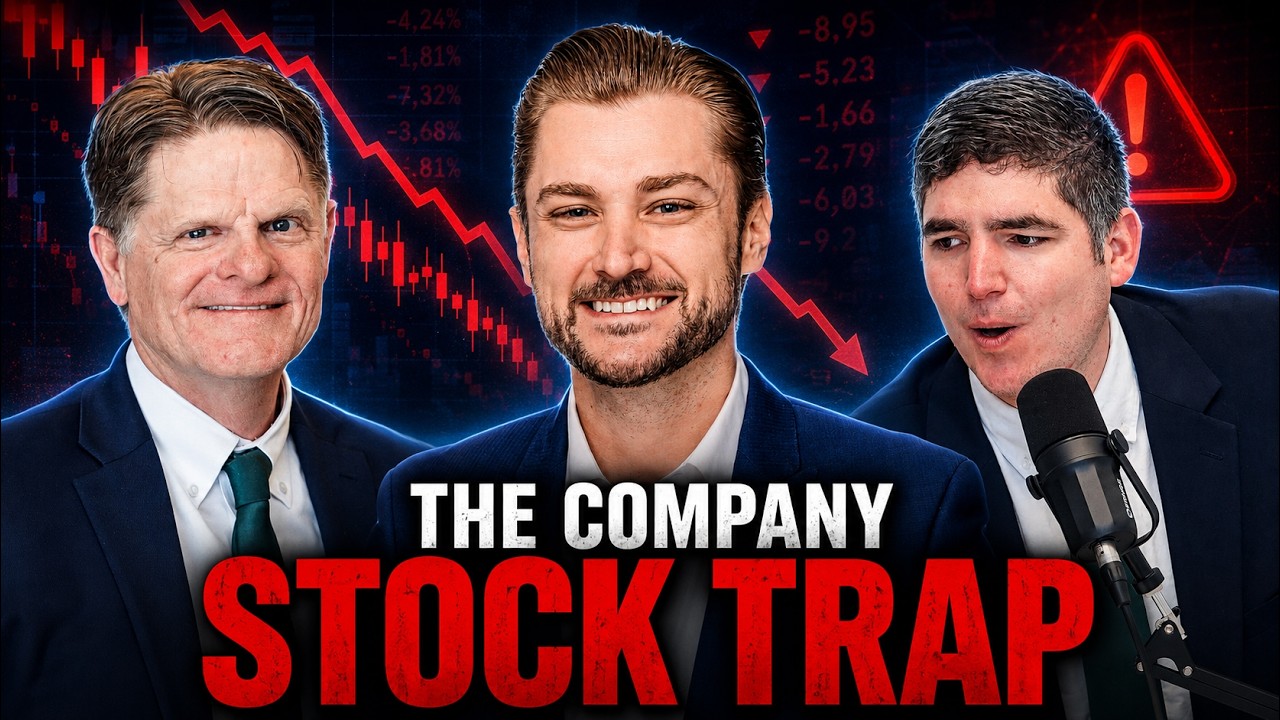
Featuring Mitch Allen, CFP® · Security Financial Management · CRD #6847163
and Mike Allen, CFP® · Security Financial Management · CRD #3153161
Episode released June 2026 · Published here September 2026
Executive Compensation Planning When Your Employer Is Also Your Largest Holding
Watch the Episode
Timestamps
- 0:54 — Why people invest in the industry they work in
- 1:20 — The Enron precedent
- 4:00 — You may already own it twice: company stock and sector ETFs
- 4:33 — What an exchange-traded fund actually is
- 5:15 — Rebalancing as a rule set in advance
- 6:24 — Filtering hype: what is real and what is noise
- 7:34 — Never all in on one thing
Why the Industry You Work In Feels Like the Safest Place to Invest
The appeal is not irrational. Someone who has spent a career inside an industry sees the demand, the order book and the revenue before any of it reaches a headline. That knowledge feels like an edge, and in some respects it is. The difficulty is that the same familiarity makes the position feel smaller than it is.
As Mitch Allen puts it in the episode, the instinct is to invest where you already understand the ground. It is the most defensible-sounding reason to end up concentrated.
The Enron Precedent
The conversation turns to Enron, and to what it looked like from the inside. At the end of 2000, according to reports at the time, about 62 percent of the assets in Enron’s 401(k) plan were in the company’s own stock. The employees who held that much of their retirement in one company were not reckless. They believed in the business, they saw nothing wrong day to day, and they treated it as a blue-chip holding. When it failed, the retirement failed with it.
Any employer can look sound from the inside. The person best placed to judge a company is often the one least able to see their own exposure to it.
You May Already Own It Twice
This is the part most households miss. An employee with company stock may also hold a sector fund bought separately, in the belief that it diversifies. It often does the opposite. A sector exchange-traded fund concentrates its holdings in one industry or market segment, so buying one in the same sector as your employer adds to that exposure rather than spreading it.
The result is an allocation nobody chose. Each decision was reasonable on its own; the combined position was never examined.
What an Exchange-Traded Fund Actually Is
Mitch Allen describes an exchange-traded fund as a basket of securities (stocks, bonds or both) bought in a single transaction, much like a mutual fund. Because of how it is structured, an ETF can be more tax-efficient than a similarly invested mutual fund, although some types, such as leveraged, inverse and commodity funds, can create tax liabilities of their own. Buy a sector fund and you own a slice of many companies in that sector at once.
That is a feature when the sector is not already where the household’s income, retirement plan and equity compensation all sit. When it is, it is a multiplier.
Rebalancing as a Rule, Not a Reaction
The discipline described is a threshold agreed in advance. A ceiling is set for how large a single position may become, the portfolio is reviewed on a fixed schedule, and when the position passes the ceiling it is trimmed back to it. The decision is made once, in calm conditions, and then followed.
The reason is stated directly in the episode: fear and greed act on professionals too. A rule written before either arrives is what makes selling into strength possible at all.
Filtering the Hype
Newer names draw the calls. The advisers describe their job as running the excitement through a filter and reporting what is left. Recommendations, they are explicit, are made per household and never in general.
Never All In on One Thing
The closing point is the one that generalizes beyond aerospace. Whatever the industry, and however well the household knows it, the plan cannot rest on a single name or a single sector. The risk being described is concentration, whichever company it happens to sit in.
Frequently Asked Questions
Is it a mistake to hold stock in the company I work for?
Not in itself. The concern raised in the episode is proportion rather than ownership: how much of a household’s total wealth depends on one employer, once salary, retirement plan, company stock and any sector funds are counted together.
Does buying a sector fund diversify my company stock?
Often it does the opposite. A sector fund concentrates its holdings in one industry or market segment, so holding one in the same sector as your employer adds to that concentration rather than offsetting it.
How do I know if I am over-concentrated?
It requires adding the holdings together across every account, including retirement plans and any funds bought independently. The episode’s point is that concentration is usually invisible until the positions are listed in one place.
What is the difference between an ETF and a mutual fund?
Both are baskets of securities bought in one transaction. An exchange-traded fund trades on an exchange throughout the day, and it can be more tax-efficient than a similarly invested mutual fund, though not every type of ETF is.
Full Conversation
This transcript has been edited for length and clarity.
ROB LOVAGLIO: Today’s episode is brought to you by Security Financial Management. Welcome back to Best Advice Podcast Guys. I’m your host, Rob Lovaglio, here as always with certified financial planners at Security Financial Management, Mitch Allen and Mike Allen. Today we’re talking about investing in the industry you work in, and how to make sure that aligns with your real portfolio and your real best interest.
MITCH ALLEN: You think you want to just invest in what you know. We’re in financial planning, so just invest in finance companies. But it’s not always the best way to go.
ROB LOVAGLIO: Because you understand it the most.
MITCH ALLEN: It’s biased investing. You understand it the most, so you go where you understand. What I always bring up with people is that the folks at Enron had a really bad time investing in their own company.
ROB LOVAGLIO: Because they liked it.
MITCH ALLEN: They liked it. They believed in it. They thought it was an Apple-level company. The day-to-day employee did not see anything wrong with it, so they had most of their retirement in that stock. And what happened?
MIKE ALLEN: I had a neighbor when everything was about to go belly up with Enron. He was away, and his wife called him and said, we have a problem, Enron is going down. He said it’ll be fine, I’ll take care of it when I get home. He got home and it was gone. They foreclosed on the house and moved out.
MIKE ALLEN: There is something to be said for a company you believe in. But you don’t put everything you have into it. You put a small piece. Diversification matters, and investing in companies you believe in matters — the question is how you marry the two.
ROB LOVAGLIO: Mitch, let’s start with the obvious appeal. If someone has spent their entire life in aerospace or defense, why is it so tempting to stay in that industry when investing?
MITCH ALLEN: You’re in the day-to-day of the company. You see the demand for the product. You see the revenue. You see everything that’s happening. And people will say, I work here, but I’m seeing exciting things going on elsewhere in the industry. We might call that an adjacent industry.
MITCH ALLEN: What you have to understand is that you may already have a lot of money invested in that industry — whether through your direct investment in company stock, or through funds you bought yourself. If you own an aerospace fund, you probably own a little bit of most of the aerospace companies out there.
MIKE ALLEN: And at least enough to take the ride.
ROB LOVAGLIO: Explain what an ETF is and how it can spread out risk.
MITCH ALLEN: An ETF is an exchange-traded fund. They’re a lot like mutual funds. It’s basically a basket of securities — it could be bonds, it could be stocks. You could buy an aerospace exchange-traded fund and it would own a slew of companies in that industry at different percentages. One purchase, and you own all of them.
MITCH ALLEN: So it’s up to us to analyze your portfolio, make sure you’re not overexposed to any one industry, and chart the path forward.
MIKE ALLEN: That’s why we have a process. Even for us it’s easy to start feeling the fear factor or the greed factor. If you have a process in place — every quarter you rebalance — then when a position goes above the level you set, you trim it back to that level. Either way, you have to stay true to your game plan.
ROB LOVAGLIO: Play this out for me. You work with a lot of employees at one company. What does it look like when you tell them not to invest everything in their own industry?
MITCH ALLEN: Obviously we can’t get into any actual recommendations, because every recommendation we make is custom to each client. But in general there’s a lot of hype right now around technology and aerospace names. It’s up to us to take the hype, put it through a funnel, and present to the client what we feel is real.
MITCH ALLEN: You have to have asset allocation across the board. It can’t just be in one name. It can’t just be in one sector. There are different things you can do based on your individual circumstances, so everything we do is custom — but you have to make sure the hype is looked at through a lens, and you have to boil it down.
ROB LOVAGLIO: And take out the noise.
MITCH ALLEN: Take out the noise, boil it down to something simple we can educate on. That’s our most important job.
MIKE ALLEN: If an engineer comes in with their spreadsheet, we take that spreadsheet and we say, this is great — and now we’re going to put a more structured financial plan together. We honor the spreadsheet, and then we look at it all together.
MITCH ALLEN: I love the saying: if we can measure it, we can manage it.
MIKE ALLEN: Never all in on one thing.
ROB LOVAGLIO: Thank you both. Remember, folks: the secret to wealth is not what you earn, it’s what you keep. Happy days, everybody.
This podcast is for entertainment and educational purposes only and is not intended as personal financial advice. Before making any financial decision, please do your own research and consult a financial adviser as needed.
Continue with the September Executive Compensation Pillar
- Insight: Executive Compensation Planning and the Closing Window
- Resource: Executive Compensation Planning
Schedule with Security Financial Management
If you would like help applying this to your plan, particularly if your compensation arrives as equity and you are not certain how much of your household depends on one employer, our team works with households across Central Florida on exactly that question.
About the Speakers
Rob Lovaglio · Host, Best Advice Podcast Guys · Security Financial Management. Rob hosts the SFM monthly podcast conversation series covering retirement, tax and estate coordination for households across Central Florida.
Mitch Allen, CFP® · CRD #6847163 · Security Financial Management. Mitch holds the CERTIFIED FINANCIAL PLANNER™ designation. Verify credentials at BrokerCheck by FINRA.
Mike Allen, CFP® · CRD #3153161 · Security Financial Management. Mike holds the CERTIFIED FINANCIAL PLANNER™ designation. Verify credentials at BrokerCheck by FINRA.
Disclosures
The information presented is for educational purposes only and does not constitute legal, tax, or investment advice, and is not a recommendation to buy, hold or sell any security. Security Financial Management, Inc. is a registered investment advisor under Kestra Advisory Services, LLC. Diversification and asset allocation do not ensure a profit or protect against loss in a declining market. Any companies referenced in the conversation are named to illustrate a general point and are not recommendations. Past performance is not indicative of future results. Securities offered through Kestra Investment Services, LLC, member FINRA/SIPC (Kestra IS). Investment advisory services offered through Kestra Advisory Services, LLC (Kestra AS). Security Financial Management, Bluespring Wealth Partners, LLC, Kestra IS and Kestra AS are affiliated through common ownership by Kestra Holdings. Verify advisor credentials at BrokerCheck by FINRA or SEC Investment Adviser Public Disclosure.